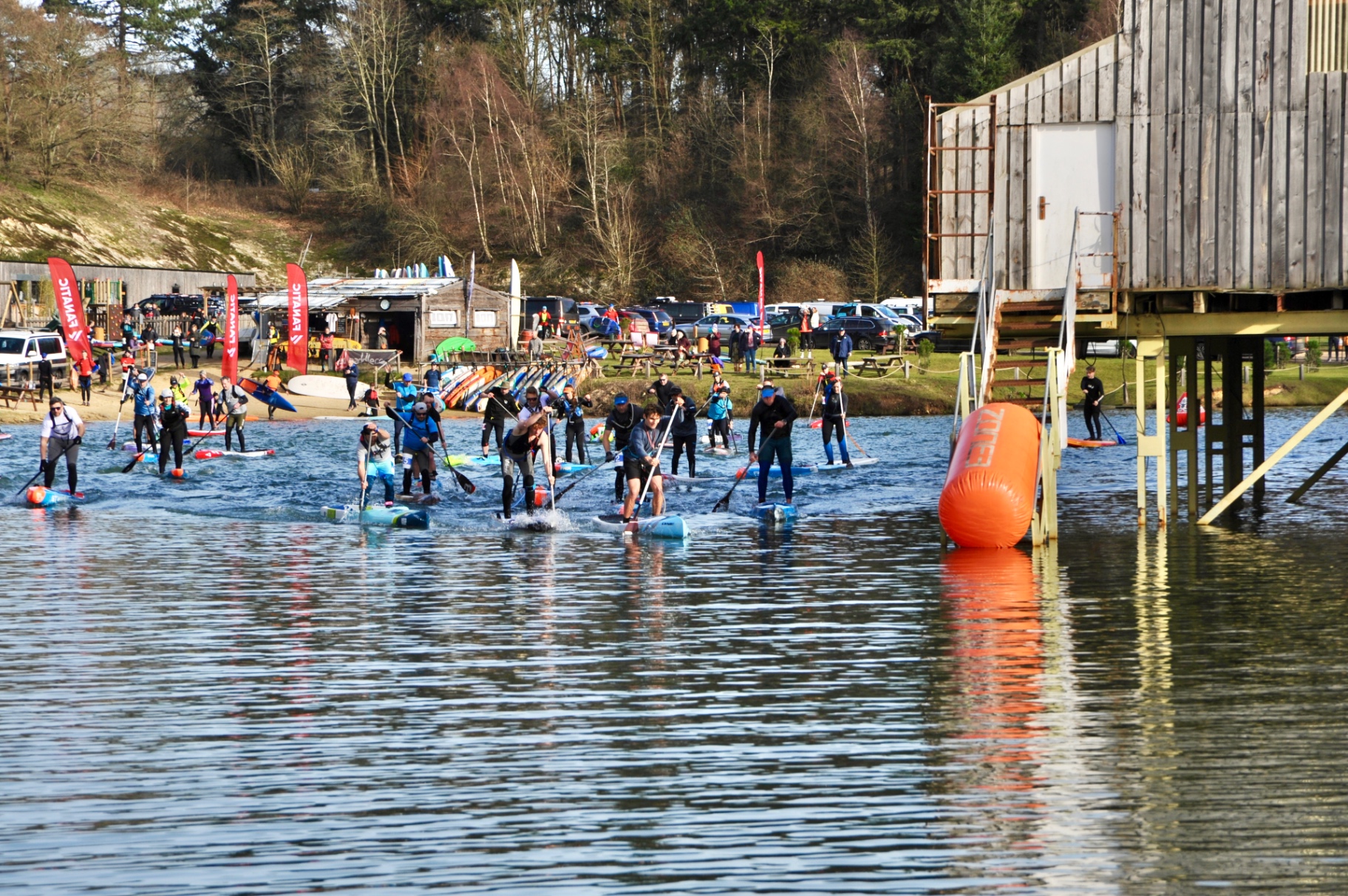
Paddleboard racers starting a SUP race on open water

SUP Races, Challenges & Adventures

There is much more to SUP than leisure paddling. Here are races, challenges and adventures that can give you something to aim for — and SHACADEMY can help you prepare for the ones that suit you.

Three broad routes

Race, challenge, or adventure — they are not the same thing

Nobody has to become a racer. Most paddlers who find this side of the sport end up somewhere in the middle: an event in the diary, and a reason to paddle deliberately instead of occasionally.

Race

Shorter competitive, technical, club and series formats.

Sprints, technical laps with buoy turns, club racing and national-series events. Usually short enough to be over in minutes to an hour or so, and decided by starts, turns and holding form when you are out of breath. The most structured way in, and the easiest to try without a big commitment.

Challenge

Endurance and long distance — timed, but not necessarily a race.

Long-distance and endurance events where completing the distance is the objective and the clock is context rather than a contest. Pacing, feeding, clothing and staying comfortable for hours matter far more than top-end speed. This is where most recreational paddlers find their biggest jump in confidence.

Adventure / expedition

Multi-day, remote, self-supported or genuinely demanding journeys.

Stage events, remote journeys and self-supported expeditions. Preparation shifts almost entirely towards logistics, repetition, sleep, cold, food, kit reliability and decision-making. Physically demanding, but far more about planning and judgement than speed.

Worth knowing about

Curated events we have not done ourselves

Described from the organisers’ own published information, and clearly marked as such. We would rather tell you where an event sits in the progression than pretend to personal experience of it.

Full calendars and trusted resources

We do not try to duplicate every event calendar. These are independent resources we find useful — we have no formal relationship with them, and their information is theirs to keep current.

  • SUPjunkie

    For a broader UK SUP race calendar and event coverage — race listings, event galleries, videos and interviews. An independent resource we rate; no partnership, sponsorship or affiliation.

  • GBSUP

    UK race listings, classes and series information, published by the organisers themselves.

  • Paddle UK

    Wider paddling events, routes and access information across the UK.

Race formats, plainly

The main shapes an event can take

Described at a high level, because every organiser sets its own programme, distances and classes. Always read the current event information before you plan around a format.

Distance racing

A straight line, or a long loop — typically anything from a few kilometres upwards. Steady pace, efficient technique and staying on someone's wash matter more than sprint speed. The most forgiving place to start if you already paddle regularly.

Technical racing

Short laps with buoy turns, and often a beach start and finish. Fast, busy and skill-heavy — turning under pressure and running in and out of the water are as important as paddling. Great fun, and a fast way to improve board control.

Sprints

Very short, very hard, usually in heats. Almost entirely about the start, catching your first strokes cleanly and holding form while you are out of breath. Low commitment, high learning.

Multi-day, adventure and challenge events

Journeys, stage races and distance challenges — sometimes competitive, sometimes purely about completing it. Preparation shifts towards logistics, feeding, clothing, repetition and recovery rather than top-end speed.

Winter and cold-water events

A distinct part of the calendar with its own culture. The paddling is often modest; the clothing, warm-up, transitions and cold-water judgement are the real subject.

Progression pathway

From recreational paddler to first event

1

Paddle regularly and honestly

An hour of continuous paddling on flat water, comfortably, in the clothing you actually own. Not fast — just consistent, and enough that a session no longer feels like an event in itself.

2

Fix the technique that fails under pressure

Most recreational stroke habits hold up fine at cruising pace and fall apart when you push. This is the point where coaching saves the most time — you stop reinforcing something you will have to unlearn.

3

Learn to go hard, and to turn

Short intervals, standing starts, and buoy turns on both sides. Nothing exotic — but almost nobody does these by accident, and they are the two things first-timers most often wish they had practised.

4

Enter something small

A short-distance or technical class at a friendly event. The aim is to learn how a race day works: registration, briefing, the start, the crowd, the finish. Placing is irrelevant.

5

Choose your direction

Some paddlers get faster; others get further. From here it splits into racing, endurance challenges, or adventure and expedition paddling — including winter events and longer journeys.

Our own event

GLAGLA UK — the UK winter SUP race and challenge

GLAGLA UK is our own winter paddle event, co-founded by Skip Innes and Craig Sawyer. It is deliberately built as a way in: a ranked Race Fleet for paddlers who want to race, and a timed but unranked Challenge Fleet for everyone who does not — same course, same clock, same day.

International races & challenges

The French Gla Gla Race, Lake Annecy

The GlaGla Race at Lake Annecy is one of the best-known winter SUP gatherings, run by its own organisers and entirely separate from ours. It is also where this started: Team SHAC raced there, and that experience led to GLAGLA UK. We can help you prepare for it — we do not handle its entries.

The GlaGla Race, explained →

Prepare with Skip

Race, challenge and adventure preparation, 1:1

Coaching here is person-centred: a few clear technical changes, better decisions, and preparation for the objective you actually have.

Private coaching built around the event you have in mind, or the one you are still deciding whether to enter. Technique under pressure, starts and turns, pacing and feeding, clothing and kit decisions, cold-water judgement, and the unglamorous repetition that longer objectives actually need.

My own background is endurance and expedition paddling more than racing — the Yukon 1000, long solo paddling, and the mileage I put in on the Wey and Arun beforehand. The approach is the same whether your objective is a 6 km race or a multi-day journey: work backwards from the day, and remove surprises.

Also useful

Why the advice is worth trusting

Adventure paddler first, with enough racing behind me to be useful

Background, kept here rather than at the top of the page: SHACADEMY’s event and challenge work is led by founder and lead coach Skip Innes, and this is the experience behind it. It is offered as proof, not as the point of the page.

I am not a specialist race paddler and I would not pretend to be. Most of my paddling is solo and adventure paddling, and most of my preparation experience is endurance and expedition work. I have raced over the years though, and taken teams to events, which is enough to understand how someone moves from recreational paddling into competition and challenges — and where that step usually goes wrong.

Where I have not done an event, this site says so. I know people involved in events like the Alabama 650, but I have not paddled it — and I have not done SUP the Creek. I have also not completed the Great Glen: I have entered and planned it a couple of times and had to withdraw, and it is still on my list. Those entries are here because they are worth knowing about, described from the organisers' own information.

  • Endurance, distance and multi-day preparation
  • Expedition planning, cold water and self-supported journeys
  • Broad environmental experience — flat water, tidal water, sea, rivers and some white water
  • Helping recreational paddlers into their first event without overreaching

Events and objectives behind the advice

  • Completed the Yukon 1000 — self-supported, and the deepest end of my own paddling.
  • Raced the French GlaGla several times, and trained and taken teams there.
  • Co-founded GLAGLA UK with Craig Sawyer, our own UK winter race and challenge.
  • Competed in GBSUP races — a series I rate, and a sensible structured way into UK racing.
  • Completed the Trent 100 as part of a team, in the early years of that event.
  • Ran the SHAC SUP race team, which attended the UK SUP Club Championships in 2018 and other events around that period.
  • Paddled Head of the Dart.
  • Raced the River Axe Race, and won it a couple of years ago.
  • White-water SUP in Scotland, mainly on east-coast rivers, paddling with my friend Jim Gibson — a very experienced white-water paddler associated with Aqua Sports Scotland.
  • A solo paddle on the River Kwai in Thailand, and a solo circumnavigation of Koh Samet.
  • Hosted and ran SHAC Attack at The SHAC a couple of years ago — a summer GBSUP race staged at our own venue.
  • Mountain-bike lead for the SUP Bike Run series, and competed in a couple of the events myself, placing well.
  • Entered the public paddle festival race alongside this year's ICF SUP World Championships on a late decision, and finished third.

Experience across the sport

Across the sport, not just on one start line

Alongside the paddling itself, a fair amount of my experience is on the other side of events — leading disciplines, running teams and delivering races — with some competing in between. It is useful context for coaching and for venues, but racing results are not what I am selling.

SUP Bike Run series

I was the mountain-bike lead for the series, responsible for that discipline within a multi-sport event format. I also competed in a couple of the events and placed well — I believe I took third in the first year, though I would not state the year or the result as fact until it is verified.

ICF SUP World Championships paddle festival

At this year's championships I entered the public paddle festival race on a last-minute decision and finished third. To be clear, that was the open festival race held alongside the championships, not the elite World Championship field.

Events run rather than entered

Co-founding GLAGLA UK, hosting SHAC Attack as a GBSUP race at our own venue, and taking the SHAC team to events — the operational side of racing, which is often more useful to a venue or an organiser than a results sheet.

Racing remains secondary to the core of what I do: adventure and endurance paddling, coaching, and the practical delivery of events and venues.

Adventure paddling behind it

Journeys, rivers and water that shaped the coaching

Flat water, tidal water, sea, rivers and some white water. These are not events with results sheets — they are the paddling that informs how we plan, prepare and read conditions. Some are still on the list rather than done, and that is said plainly.

Kanchanaburi, Thailand

River Kwai, Thailand

A solo paddle on the River Kwai, including under the famous bridge.

A solo river paddle in Thailand, planned and run without support. Hot-climate paddling brings its own problems — water, sun, river traffic and the practicalities of getting on and off the water somewhere unfamiliar.

To Skip's knowledge, this was the first documented paddleboard passage beneath the Bridge over the River Kwai. It is stated as his own evidence-led account rather than an independently verified record, and never as a straightforward first.

Skip holds contemporaneous photographs of the paddle and is not aware of any earlier documented photographic evidence. The archive will be assembled here before the wording is strengthened.

Koh Samet, Thailand

Koh Samet circumnavigation

A solo circumnavigation of the island by paddleboard.

An unsupported solo lap of the island — a sea paddle with exposure, boat traffic and changing wind on the open sides, and a planning problem as much as a paddling one.

To Skip's knowledge, this was the first documented paddleboard circumnavigation of Koh Samet. It is his own evidence-led account rather than an independently verified record, and is not presented as a straightforward first.

Documented at the time with photographs, and no earlier documented paddleboard circumnavigation is known to Skip. The supporting archive will be published here before the claim is put more strongly.

Northern Thailand

A river paddle in northern Thailand

A substantial river paddle in the north of Thailand, many years ago.

A long river paddle in northern Thailand, done years ago and without support. Skip's memory of it is as much about the reaction as the paddling: local fishermen appeared unfamiliar with paddleboards on that water. It was hot-climate river paddling — sun, water, river traffic and unfamiliar access — and it remains one of the trips he most wants to write up properly.

Skip has video footage from the trip. No claim of a first is made for this paddle — the fishermen's reaction is recounted as his own recollection, not as evidence of one, and nothing stronger will be said unless evidence is assembled and verified.

Scotland — mainly east-coast rivers

White-water SUP in Scotland

White-water paddling on Scottish rivers with Jim Gibson.

White-water SUP is a different discipline again: reading moving water, falling off well, and accepting that the river decides. Paddled mainly on east-coast rivers alongside Jim Gibson, a very experienced white-water paddler associated with Aqua Sports Scotland.

River Trent, England

Trent 100 (historic)

Completed as part of a team in the event's early years.

A long-distance river event Skip completed with a team in its early years. It has not run recently and may no longer be active — it is included as past experience, not as a current objective.

Aspiration, not experience

On the bucket list — adventures I would love to paddle

Separate from anything already paddled: objectives Skip has researched and would like to do. Nothing in this section has been completed, and it is here as intent and research rather than experience. Where an event or a river is described, the factual detail comes from the organiser or the land manager and should be checked with them — formats, seasons and booking rules change.

Not done — on the list

Massive Murray Paddle (MMP415)

Murray River, Australia

A 415 km, five-day paddling adventure race down the Murray River.

A long-standing Australian multi-day event covering roughly 415 km over five days on the Murray River, running between riverside towns with staged finishes each day. The organisers offer shorter personal distance targets as well as the full route, and fundraising for community causes is part of the event's character rather than an add-on.

It is the shape of event Skip actually enjoys: distance, repetition, staged days and self-management rather than a single sprint. It is on the list, not on the record.

Current-edition information: The organisers publish the current edition's dates, stage towns, distance options and entry process each year — take those from them rather than from here.

Massive Murray Paddle (MMP415) — official site

Not done — on the list

Whanganui Journey

Whanganui National Park, New Zealand

A 145 km river journey through remote North Island bush and valleys.

New Zealand's Department of Conservation lists the Whanganui Journey as a 145 km river trip through Whanganui National Park, usually taken over five days from Taumarunui to Pipiriki, with a shorter 88 km option over three days. It is a Great Walk done by water, needing genuine paddling skill and fitness rather than walking experience, with huts and campsites booked in advance. The river holds legal status as Te Awa Tupua, and DOC is explicit that conditions outside the Great Walks season are more hazardous and only for the very experienced.

A remote, multi-day river journey with real cultural weight, which is exactly the kind of adventure paddling Skip is drawn to. Not paddled, and no plan is claimed beyond wanting to.

Current-edition information: Season dates, booking requirements, skill guidance and safety rules are DOC's and change — check their current Whanganui Journey information before planning anything.

New Zealand DOC — Whanganui Journey

Not done — on the list

A return to Thailand

Thailand

More paddling and adventure work in a country Skip already knows.

Skip has paddled in Thailand before — the River Kwai, a circumnavigation of Koh Samet and a long river paddle in the north — and intends to return for more paddling and adventure work there. Nothing is scheduled or offered as a trip: this is an intention, and any future paddling or work there would be described once it exists.

Familiar water, hot-climate river and sea paddling, and unfinished journeys he would like to go back for.

Not done — on the list

The Great Glen

Scotland — Fort William to Inverness

Entered and planned twice, withdrawn both times. Still unfinished.

Skip has not completed the Great Glen. He has entered and planned it a couple of times and had to withdraw on both occasions, so it sits here as an objective rather than as experience.

A UK coast-to-coast journey with lochs, canal sections and real weather exposure — and one he wants to finish.

Common questions

Do I need a race board to enter my first SUP race?

No. Most events run classes that accept the kind of inflatable or all-round board recreational paddlers already own, and plenty of first-timers use exactly that. A narrower race board is faster, but board choice is rarely what decides whether a first event goes well — pacing, turns, starts and being comfortable in the conditions matter far more.

How fit do I need to be for a short SUP race?

If you can paddle steadily for an hour on flat water without needing a long rest, you have enough base for a short-distance event. The bigger jump is usually intensity rather than duration: races start fast, and most people have never paddled hard from a standing start in a crowd before.

What does race and challenge preparation with SHACADEMY involve?

Private 1:1 sessions with Skip, built around your objective rather than a syllabus — technique that holds up under pressure, starts and buoy turns, pacing and feeding for longer distances, kit and clothing decisions, and the practical planning behind travel, cold water and multi-day events.

Is Skip a race specialist?

No, and it would be misleading to say so. Skip is an adventure and endurance paddler first — solo and expedition paddling, and preparation for long objectives like the Yukon 1000. He has raced over the years, taken teams to events and run a club race team, which is enough to know the progression pathway well. His strongest ground is challenge, endurance and adventure rather than elite racing.

Is challenge paddling the same as racing?

No, and that distinction matters. A challenge or adventure event is usually about completing a distance, a journey or a set of conditions rather than beating other paddlers. Many people who never want to race enjoy challenge paddling — the preparation overlaps, the mindset does not.

Event dates, distances, classes, entry requirements and rules are set by organisers and change. Nothing here is an entry service, an endorsement or an affiliation — other than GLAGLA UK, which SHACADEMY co-founded. Always enter through the official organiser and read their current information before planning travel or training around an event.

For venues

Want to bring SUP racing to your venue?

Plenty of venues already have paddlers on the water and no event offer at all. Introducing a race or a challenge day is mostly an operational problem rather than a sporting one — course, flow, categories, safety cover, staffing, timing and what happens if the weather turns.

SHAC Attack

A couple of years ago we hosted SHAC Attack at The SHAC — a summer GBSUP race staged at our own venue, run by Skip and the team. It was a good event, and the value of it here is what it took to deliver: a course that worked, a fleet structure people could enter, safety cover matched to the format, and a race day that ran to time. Skip has since talked with Scotty about the possibility of running events at the venue again.

This is an example of experience, not a suggestion that every venue should run races. Some venues are better served by a challenge day, a time trial or nothing at all — and where an event carries a series or governing-body status, that comes from the body involved, not from us.

On technology

On technology we stay provider-neutral: connect where possible, build where necessary. Most events are best served by a capable system that already exists — GBSUP, for example, runs its own timing, results and series standings — so the useful work is usually understanding your requirements, designing the workflow around them and connecting the right tools. We have built and run event systems ourselves, including for our own GLAGLA UK, and that experience informs the advice. We do not sell timing software.

This connects to SHACADEMY's wider water safety and operations work, and to the operational and systems side of running events.
  • Event concept — what kind of event actually suits your water, your paddlers and your season.
  • Course and format design, including lap structures that work for mixed abilities.
  • Categories and waves, so entry-level paddlers are not put on the line with the fast fleet.
  • Participant flow: registration, briefings, marshalling, starts, finishes and getting people off the water.
  • Safety and operational planning, water cover and staffing levels for the format you choose.
  • Timing and data requirements — what you need to capture, and how results hold up to scrutiny.
  • Race-day delivery support alongside your own team.
  • Choosing and connecting suitable timing, entry and race-management systems, provider-neutral, rather than spreadsheets on the day.