Expedition & Personal Development Case Study
Yukon 1000 — Four Years to the Finish Line
1,000 miles. 8½ days. Four years to reach the finish line.
The story of the first British SUP team to complete the Yukon 1000 — and what four years of preparation, setbacks, problem-solving and wilderness taught us about resilience.
The Yukon 1000 is the world's longest paddle and survival race: approximately 1,000 miles of unsupported wilderness river from Whitehorse in Canada's Yukon Territory to the Dalton Highway bridge in Alaska, crossing the Arctic Circle along the way.
In 2023, Scott 'Skip' Innes and Craig Sawyer completed the course by stand-up paddleboard in 8 days, 13 hours and 3 minutes, winning the SUP division and becoming the first British SUP team to successfully complete the event.
But the finish line was four years in the making.
At a glance
- Year
- 2023
- Distance
- 1,000 miles, unsupported
- Result
- 2023 SUP division winners
- Finish time
- 8 days, 13 hours and 3 minutes
Focus areas
- Expedition Preparation
- Resilience
- Decision-Making
- Equipment & Systems
- Environmental Awareness
- Teamwork
- Problem-Solving
Section 1
The challenge
The idea began with a simple question.
Skip and Craig met through paddleboarding at a SUP-bike-run event in Wales. Both were at a point in their lives where they wanted to test the boundaries of what they could achieve, physically and mentally, and began looking for a challenge big enough to do that.
They found the Yukon River Quest, described as one of the longest paddle races in the world.
Their response was immediate:
If that's not the longest, what is?
The search led them to the Yukon 1000.
Approximately 1,000 miles of remote river. Fully unsupported. Through Canada's Yukon Territory and into Alaska. Across the Arctic Circle and through an environment where competitors need to be capable not simply of racing, but of looking after themselves when outside help may be a very long way away.
They decided to attempt it on stand-up paddleboards.
Section 2
Four years to the start line
What was intended to be an expedition became a four-year exercise in preparation, disappointment, adaptation and resilience.
The COVID pandemic caused the race to be cancelled twice.
Each cancellation meant stepping away from months of physical training, logistics, equipment preparation and mental commitment — before preparing to do it all again.
When the race returned, Skip and Craig travelled back to the Yukon ready to finally start.
Then Craig contracted COVID.
Despite having made it all the way to the start line, the decision was made not to race.
Taking an unwell paddler into an unsupported wilderness environment would have been irresponsible. There was also the possibility of Skip becoming ill during the race and the wider responsibility of avoiding carrying COVID into small, remote communities along the route.
It was the right decision.
That didn't make it an easy one.
After years of preparation and repeated setbacks, walking away again was the lowest point of the project. For several weeks, Skip questioned whether he had the energy — or even the desire — to start the whole process again.
Eventually, the reason to return became bigger than the disappointment.
Part of it was personal: to demonstrate to his children that setbacks don't have to decide the outcome. Dreams are worth reaching for. Win or lose, sometimes the important thing is having the courage and resilience to go back and give them a proper attempt.
So they committed to the Yukon again.
On film
Filmed before the outcome was known
Filmed during the first attempt at the race, this short film records the preparation as it happened — the training, the logistics of ten unsupported days, and the decision to accept the postponement — before anyone knew how the story would end.
Section 3
Preparation, research & problem-solving
The additional years weren't wasted.
They became part of the preparation.
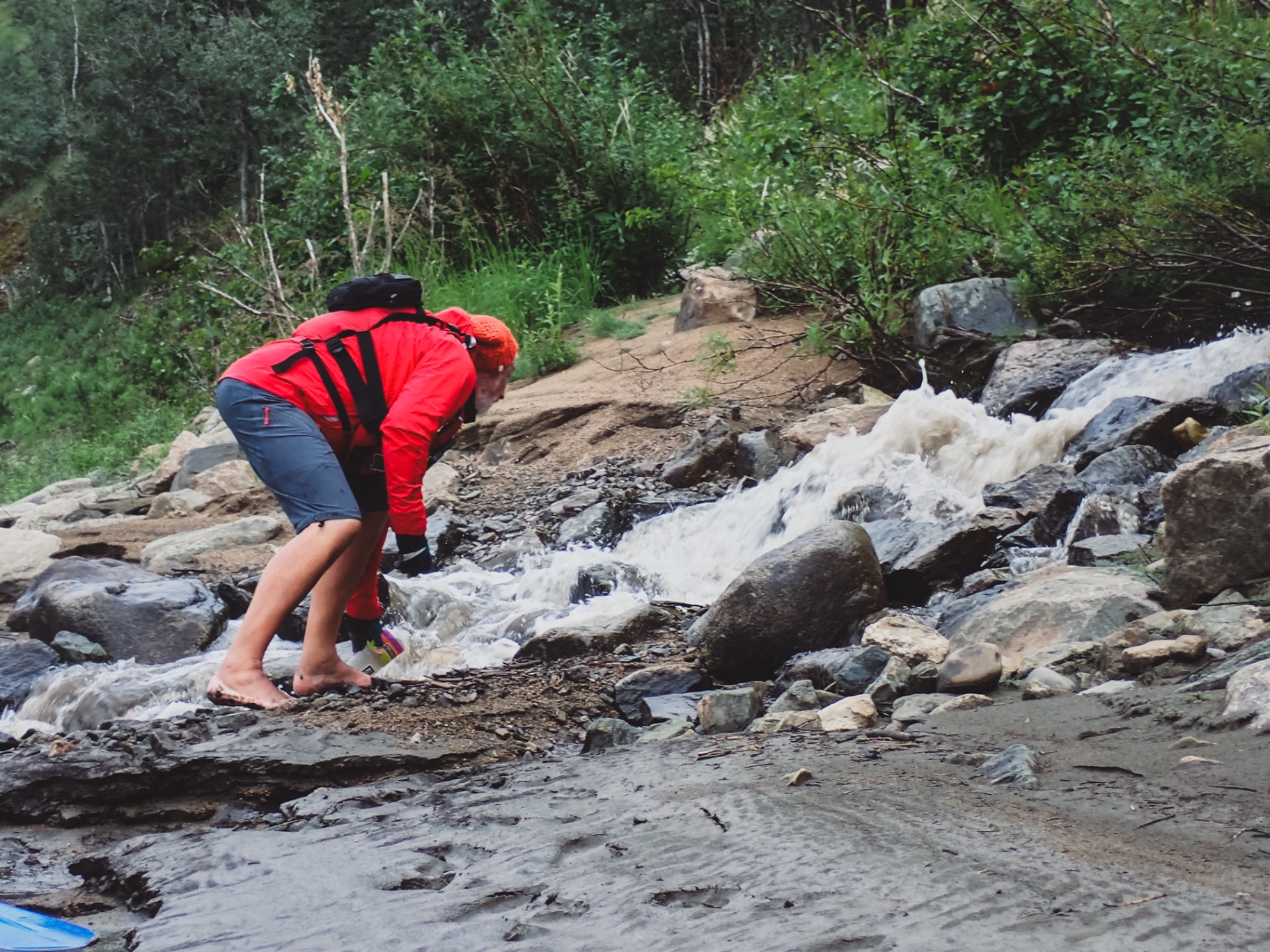
Skip and Craig travelled through the Yukon and Alaska while other competitors raced, gaining first-hand understanding of the environment they would eventually need to cross. They paddled, wild camped and learned more about the landscape, conditions and practical realities of operating in remote wilderness.
Preparation involved far more than physical training.
The pair researched equipment, expedition systems, navigation, camping, survival requirements, logistics and contingencies.
They brought different strengths to the project: Craig led much of the technical mapping and navigation work, while Skip focused particularly on researching equipment, developing specialist relationships and finding organisations capable of supporting the expedition.
Finding the right paddleboard alone became a multi-year process.
After investigating different options, the team eventually partnered with Swedish manufacturer Yster and selected its 17-foot expedition boards — equipment capable of carrying the supplies required for a 1,000-mile unsupported journey while still performing over enormous distances.
Relationships were also developed with specialist outdoor and water-safety organisations including Mustang Survival, Palm, Nordisk and Ocean Specific, alongside other technical, nutrition and hydration partners.
The result wasn't one piece of equipment or one training programme.
It was a complete expedition system, developed through research, testing, specialist input and repeated learning.
Section 4
The event
The Yukon 1000 begins in Whitehorse and follows the Yukon River north and west through increasingly remote wilderness before crossing into Alaska and eventually reaching the Dalton Highway bridge.
Competitors are unsupported and carry the equipment and supplies needed to complete the journey. Teams may paddle for up to 18 hours each day before a mandatory overnight stop.
Traditionally, two-person teams compete together in a tandem canoe or kayak.
SUP is different.
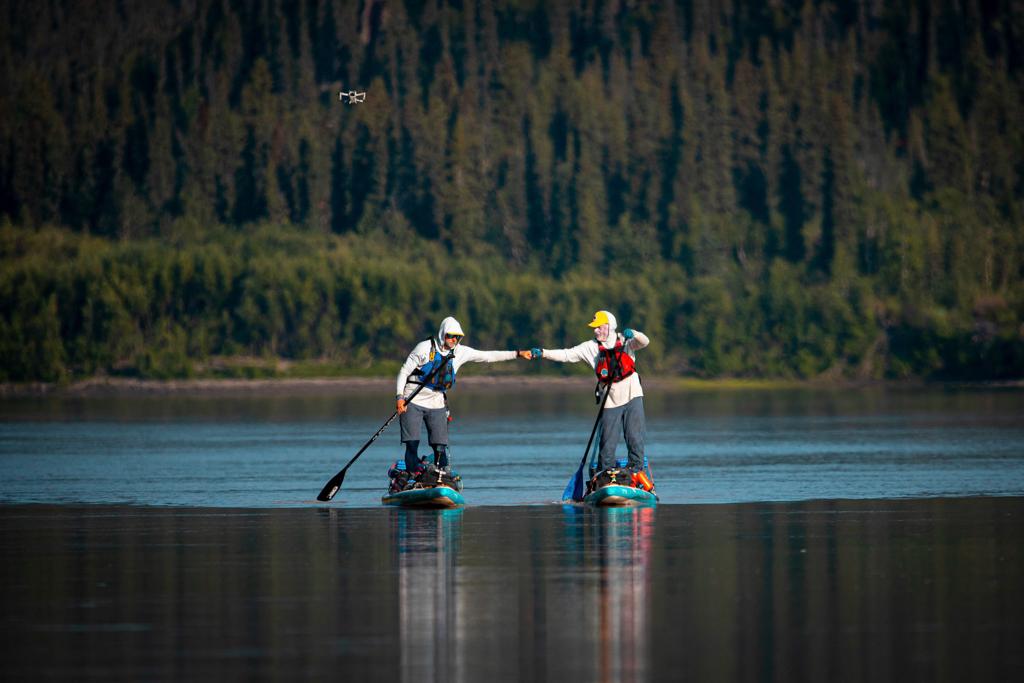
Each paddler travels on their own board while remaining close enough to operate as a team. There is nobody else in the craft to share the physical workload.
Every mile has to be paddled.
Every stroke has to be made personally.
And there are approximately 1,000 miles of them.
Section 5
Lake Laberge
One of the first major tests comes almost immediately.
Lake Laberge is a vast body of water on the Yukon route. Unlike the river, there is no current carrying competitors towards the finish. Progress has to be earned entirely through paddling, often for hour after hour.
Among Yukon competitors there is a saying:
Make the lake and you make the race.
On the first day, something clicked.
After years spent trying to reach the Yukon 1000 start line, Skip found himself unexpectedly calm. He settled into his stroke, found a rhythm and felt physically strong.
When Craig experienced periods of fatigue and doubt during the crossing, Skip was able to maintain the pace and help keep the team moving.
They crossed Lake Laberge strongly.
For Skip, it became one of the defining moments of the expedition.
After years of wondering whether they would ever get their opportunity, the lake provided the first real evidence that they belonged there.
The confidence from that crossing helped set the tone for everything that followed.
Section 6
The outcome
Eight days, thirteen hours and three minutes after leaving Whitehorse, Skip and Craig completed the Yukon 1000.
- 1,000 miles
- Whitehorse, Yukon Territory to the Dalton Highway bridge, Alaska — fully unsupported.
- 8 days, 13 hours, 3 minutes
- Elapsed time on the water from the Whitehorse start.
- 2023 SUP division winners
- First place in the stand-up paddleboard class.
- First British SUP team
- The first British SUP team to complete the Yukon 1000.
The result mattered.
But so did everything it had taken to reach it.
Section 7
Resilience doesn't always mean carrying on
One of the most important lessons from the Yukon happened before the successful race even began.
Resilience is sometimes misunderstood as continuing regardless of circumstances.
The decision not to take an unwell teammate into the wilderness demonstrated the opposite.
Good judgement sometimes means stopping — even when years of preparation, money, emotion and expectation are telling you to carry on.
The resilience comes in what happens next.
- 01
Reassess.
- 02
Learn.
- 03
Recover.
- 04
Prepare again.
And, when the time and conditions are right, return.
In Skip's words
What the Yukon taught me
The Yukon ultimately became about more than endurance.
Spending days travelling through wilderness, disconnected from technology, normal routines and much of the noise of everyday life created space for something else: reflection.
There is value in being disconnected.
There is value in being somewhere difficult.
And there is value in occasionally discovering what remains when many of the things we normally surround ourselves with disappear.
The experience changed Skip fundamentally — not always immediately or comfortably — and some of those lessons continue to unfold years later.
It reinforced a belief that challenge can be an extraordinary tool for personal development.
Not everybody needs to paddle 1,000 miles through the Yukon.
But there is something powerful about finding, at least once in your life, something that genuinely challenges your perception of what you're capable of — and giving it a go.
Section 9
Why it matters to SHACADEMY
The Yukon 1000 wasn't a SHACADEMY project.
It was one of the experiences that helped shape the thinking behind SHACADEMY.
Research before action. Understanding the environment. Finding the right equipment rather than simply the available equipment. Bringing specialist people and organisations together. Preparing for what might go wrong. Making responsible decisions when circumstances change. Learning from setbacks rather than hiding them.
And recognising that human performance isn't just about technical competence.
It is also about judgement, resilience, relationships, self-awareness and the ability to keep learning.
Those principles now run through the way SHACADEMY approaches people, projects, venues and challenges.
Watch the story
The story became a documentary — Push Past Impossible
The Yukon 1000 journey and the wider stories behind the race were captured in Craig Sawyer's documentary Push Past Impossible, featuring Skip and Craig's 2023 expedition.
The film was made and released by Craig Sawyer. SHACADEMY did not produce, distribute or own it — Skip appears in it as one half of the paddle team.
Related SHACADEMY services
How this experience supports our work
Expedition & Challenge Preparation
Practical preparation, coaching and specialist support for people taking on ambitious outdoor and endurance challenges.
Explore →Speaking & Workshops
Real-world lessons in resilience, preparation, decision-making and personal development drawn from the Yukon 1000 and more than three decades working in outdoor environments.
Explore →Start a conversation
Thinking about a challenge of your own?
Whether you're preparing for an expedition, developing a team or simply exploring an idea, start a conversation with SHACADEMY.