Private SUP Lessons & Paddleboard Coaching
Private paddleboard lessons and SUP coaching in Surrey and the Surrey Hills, developing the whole paddler on inland water and rivers — whether you are starting out, sharpening technique, or preparing for a race or distance objective.
What this covers
From first sessions to sprinting, turns and longer journeys.
Plenty of people can stand up on a board. Fewer are confident reading a river, holding a line in wind, recovering calmly after a swim, or planning a longer day on the water. That gap is where this coaching sits.
- Beginner private introductions, without a queue of other beginners.
- Progression beyond the basics, when sessions have stopped feeling like progress.
- Paddle stroke development and efficiency — paddling further for less effort.
- Acceleration and sprint technique, including starts.
- Buoy turns and other turning skills.
- Board control, trim and staying settled at different speeds and in moving water.
- Race skills and preparation for a first SUP race or personal performance goal.
- Distance and endurance technique, pacing over longer sessions.
- Environmental understanding: rivers, flow, wind, hazards and access.
- Practical safety and self-rescue.
- Journey and trip preparation — route, kit, food, contingency.
- Personal challenges and expedition preparation, scoped around your plan.
Whether the goal is a first race, a cleaner turn, or a longer journey, the same idea applies: become a better, more capable paddler. The coaching focuses on inland water and rivers, where Skip’s experience is strongest. It does not cover specialist coastal SUP coaching.
The first coaching session is £150, including the discovery work before we meet. See coaching & pricing →
Beginners welcome
Looking for SUP or paddleboard lessons near you?
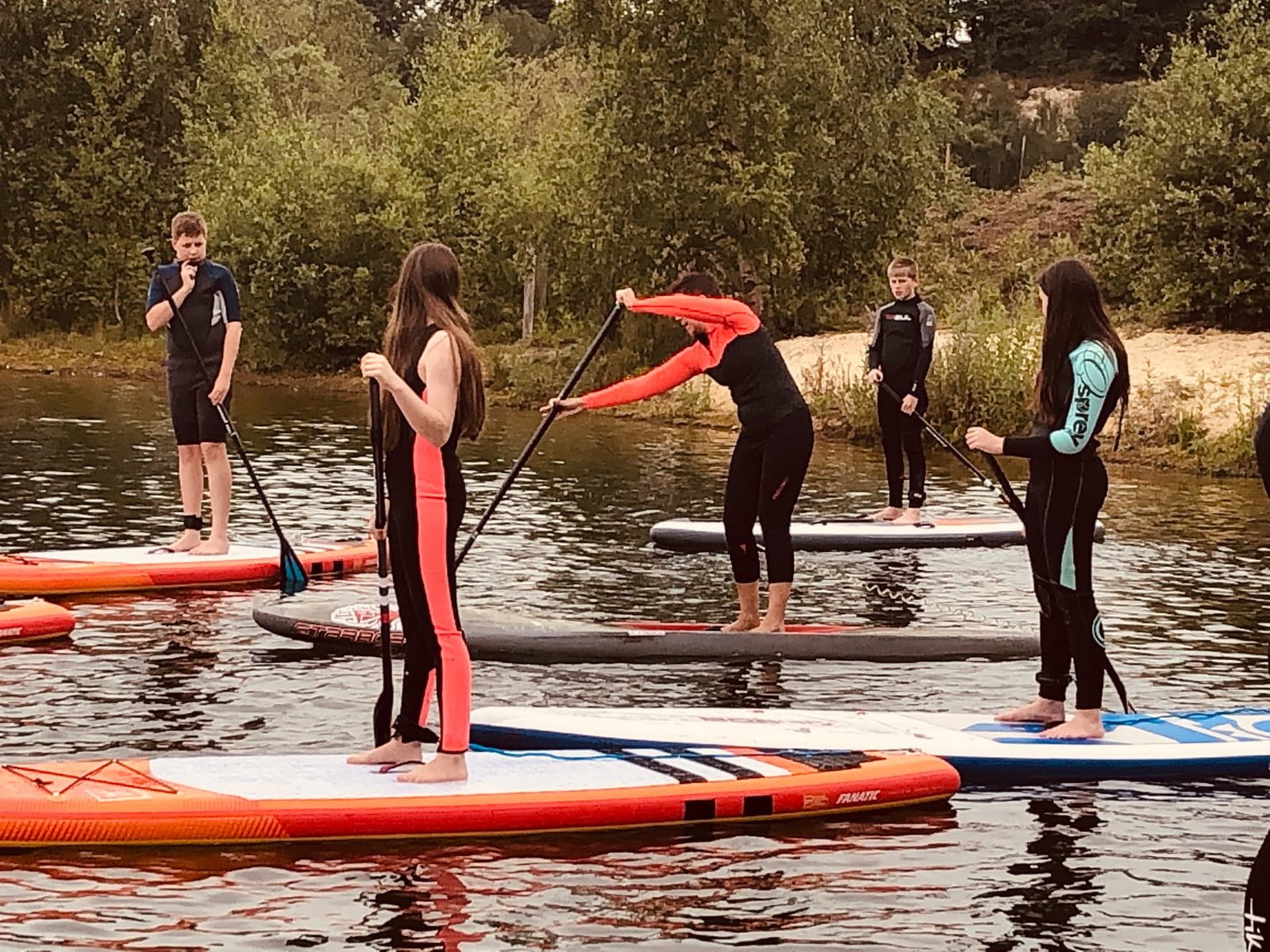
Never paddled before? Private SUP and paddleboard lessons are available for complete beginners. The first session covers the foundations properly and gives you time to understand the equipment, technique and environment:
- Equipment and board setup, and why it matters.
- Stance, balance and getting comfortable on the board.
- Paddle technique — the stroke itself, done properly from the start.
- Steering, turning and board control.
- Reading the environment: wind, flow, hazards and access.
- Practical safety and self-rescue.
- Understanding why each technique is used, not just copying it.
What sets this apart from a group beginner lesson is how personal it is and how far the tuition goes, not your starting ability. Sessions run on suitable inland water and rivers, and the same approach continues if you later want to paddle further, faster or on longer journeys.
Sessions are arranged on suitable water in Surrey and the Surrey Hills, including around Reigate, Dorking, Guildford, Crawley and Horsham depending on the coaching required.
For the rivers Skip knows first-hand — and what each one asks of a paddler — see Where to Paddle. Coaching can be arranged at those locations where access and conditions allow.
Thinking further ahead? See SUP races & challenges for race formats, a first-event pathway and winter events including GLAGLA UK.
Travelling from London? For London-based clients, sessions can be arranged at suitable venues in Surrey and selected London locations, depending on activity and venue availability — see SUP coaching for London.
SUP and paddleboard hire
Arranged multi-day SUP hire for holidays, long weekends, events, races and similar use. This is not a walk-up, on-the-day hire service.
Standard hire
Inflatable touring SUPs
Fleet of 8
Versatile inflatable touring boards, matched to the paddler and intended use. Supplied as a complete package:
Board, Bag, Hand pump, Paddle, Leash.
4-day hire — £100
8-day hire — £200
Premium hire
Hard race and surf SUPs
2 race boards and 2 surf boards
14ft hard race boards and hard surf SUPs, offered only where suitable for the paddler and intended use, and where available.
4-day hire — £150
8-day hire — £250
Hard race and surf boards require a suitable roof rack for transport.
PFD / buoyancy aid hire
Optional add-on
4 days — £20
8 days — £40
Electric pump hire
Optional add-on (inflatable boards)
4 days — £20
8 days — £40
Board choice — including race boards and surf SUPs — is matched to the paddler and intended use where appropriate and available.
Standard hire terms apply; full hire terms will be shown before booking.
Online date selection and booking are being prepared. For now, enquire below and we will confirm availability, board choice and terms.
How the coaching works
Coaching built around what you are trying to do
My job is not to show you how I paddle or swim. It is to work out what is actually holding you back, change the one or two things that will make the biggest difference, and explain them clearly enough that they stay with you when I am not there.
On a paddleboard
Adventure, endurance and solo paddling first, across flat water, tidal water, sea, rivers and some white water — with real race experience behind me, including GBSUP rounds, and enough of it to understand the pathway. Strongest on technique and efficiency, journey and expedition skills, confidence, reading conditions, and preparing for a challenge — not on elite racing, and I would not claim otherwise.
- Spotting the simple technical change that makes a real difference.
- Explaining it clearly — and why it works, not just what to do.
- Adapting to the individual rather than running a fixed programme.
- Building confidence without overcomplicating things.
- Decision-making and mental approach as much as physical skill.
- Understanding the environment: water, weather, conditions and consequences.
- Practical skills for the specific water you will actually be on or in.
- Preparation for a personal goal, an event, a challenge or an adventure.
Skip’s SUP Tips
Autumn & Winter Paddleboarding — Skip’s SUP Tips
The season isn’t over.
Autumn and winter change both sides of paddling at the same time. The water is quieter, the light is better than it gets all year, rivers behave differently and there is surf about that simply isn’t there in July. The cold, the wind, the shorter days and the consequences of ending up in the water all change too. None of that makes the colder months automatically good or automatically off — it means the decisions matter more. These are the things I actually think about, so you can read the opportunity and the risk together rather than one without the other.
01Look at the wind before you look at the route
Wind decides more of your day than distance does. Before I think about where I am going, I look at the strength, the direction and whether it is meant to change — and at whether it will be pushing me away from where I can get out.
A pleasant paddle out with the wind behind you is the part that feels easy. The way back is the part that decides whether the plan was any good. Through autumn and winter that matters more, because there is less daylight in hand if the way back takes twice as long as you expected.
02Start with water that gives you room to learn
Early on, you want water that lets you make mistakes cheaply: somewhere sheltered, somewhere you can get in and out easily, somewhere a fall in means getting back on rather than a problem to solve.
Skills built somewhere forgiving travel with you. Skills learned somewhere unforgiving tend to be learned the hard way, if at all. In colder months the forgiving option is worth even more, because everything that goes wrong costs you more quickly.
03Falling in isn’t the problem; getting back on matters
Everybody comes off. That part is normal and it is not the thing to worry about. What matters is whether you can get back on, in the kit you are actually wearing, in the water you are actually on.
So practise it somewhere easy, and practise it in your buoyancy aid and the clothing you will genuinely have on rather than in ideal conditions in a costume. Winter layers change how a remount feels. If it is hard in the shallows on a calm day, it will not be easier later.
04Your leash needs to suit the water, not just the board
The leash that came in the box is not automatically the right leash for where you are going. The type of water — still, moving, tidal, coastal — is what decides it, and there are environments where the answer is different again.
Paddle UK publishes current guidance on choosing a leash by environment, and that is the one to read rather than taking my word for it. What I will say is: know how to release yours, and always wear it the same way so you know where the release is without looking.
05Dress for being in the water, not standing on the board
It is easy to dress for the forecast on land and forget that the deciding factor is how you will feel once you are in the water, wet, with wind on you. That gap is at its widest on a bright, still autumn morning.
Think about how likely immersion is, how cold the water is rather than the air, and how long you would be in it before you were somewhere warm again. Then dress for that.
06The board is part of your safety system
The board is a large, buoyant thing you are attached to, and staying with it is usually better than swimming away from it. That is why the leash matters so much, and why chasing a loose board is the situation you are trying not to be in.
Treat it as equipment rather than a toy: check the fin, the pressure, the leash attachment and the paddle before you get on, not after something has gone wrong. Cold weather changes board pressure, so it is worth a proper look rather than a glance.
07Know the rules of the water before you arrive
Most inland water belongs to somebody, and plenty of it needs a licence, a permit or permission before you paddle. Launch points, parking and craft restrictions vary from one place to the next, and some of them change with the season.
Find that out from whoever governs the water before you load the car. Turning up and hoping is how people end up somewhere they should not be.
08Good water can still have a bad day
The place that suited you last month can be completely different after heavy rain, in a strong wind, on a big tide or with a notice up. A destination being generally fine is not the same as it being fine today.
This is the one I would keep if I could only keep one. More water in a river is not the same as better paddling — it can mean more flow, more debris, different exits and less margin. Check the current picture every time, from the people who run the water, and treat your own eyes at the launch as the final say.
09Make the launch and landing part of the plan
Getting on and getting off is where a lot of the difficulty actually lives: steep banks, slippery steps, boat traffic, weed, a landing spot that looked fine from the map and is not. Autumn adds mud, leaves and less light to all of it.
Know where you are getting out before you set off, and know your alternative if the first one does not work.
10Take a way of calling for help — and protect it
Carry something you can call for help with, and keep it dry and on you rather than strapped to the board. A phone in a pocket on a board that has drifted away is no use to anybody.
Tell somebody where you are going and when you expect to be back, too. It costs nothing, and it matters more when you are paddling alone, off-season, in the dark half of the year.
11Don’t let the equipment make the decision for you
Owning a board, a buoyancy aid or a wetsuit tells you what you have, not where you should go. Good kit widens what is possible; it does not supply the judgement, the skills or the local knowledge.
That applies to the seasonal opportunities as much as anything else. Quieter water, changing rivers and surf on the coast are genuine reasons to go paddling in the colder months — but only if your competence, the conditions, the permissions and today’s checks all line up. The question is always the same: given this water, this forecast, this day and where I actually am as a paddler, is this a good idea?
12You don’t have to prove anything
Changing the plan is a valid decision, and so is not getting on the water at all. Shortening the route, staying in the sheltered bit, going another day — those are good paddling decisions, not failures.
Nobody is marking you. The paddlers I trust most are the ones who turn round early without making a thing of it. And when you do get off the water, treat the end as part of the paddle: dry kit, warm layers, out of the wind, something warm to drink, and time to warm back up properly.
Practical advice from experience, shared as it would be beside the water. It isn’t a safety standard or a rule, and it doesn’t replace the rules of the water you are on, current national guidance, suitable safety cover or your own judgement on the day.
Longer journeys
Preparation, from practical experience.
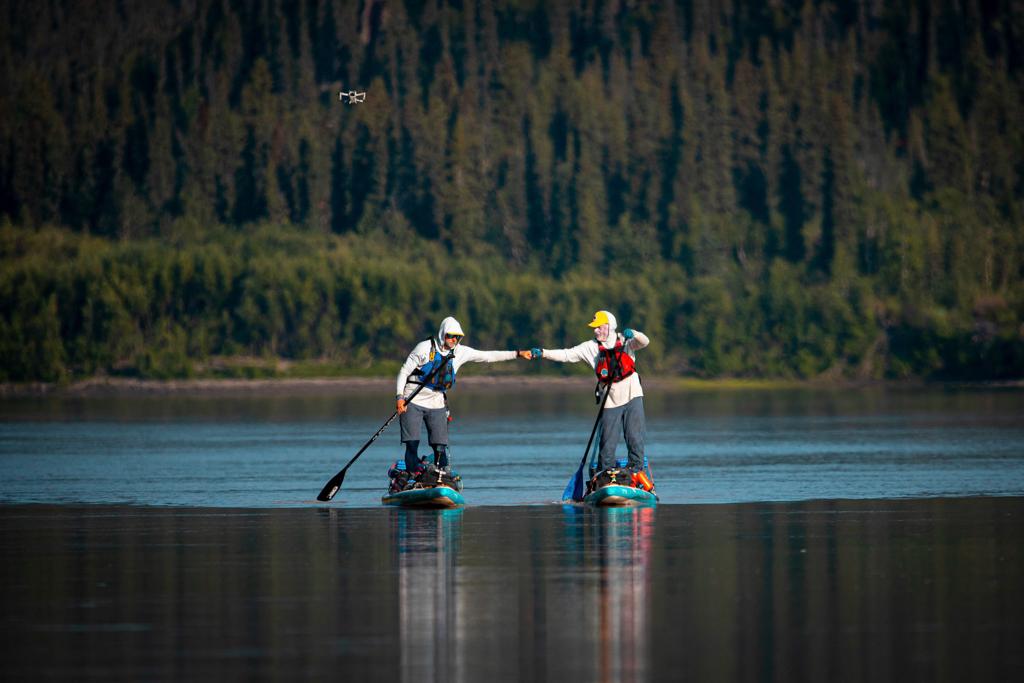
In 2023 Scott “Skip” Innes and his paddle partner won the Yukon 1000 SUP division, as part of the first British pair to attempt and successfully complete the event. It is useful here only for what it taught about preparation, pacing, kit and decision-making a long way from help.
If you have a journey or challenge in mind, tell us about it. Where Skip’s experience is relevant, SHACADEMY may be able to support your preparation.
The approach
You may only need one session.
That's why the first session is deliberately thorough. Before we meet, we'll understand what you're trying to achieve and where you are now. Then we concentrate on identifying the things likely to make the biggest difference, explaining why they matter, and giving you something useful to work with afterwards.
You may decide that's enough. That's absolutely fine. If there's genuinely more you'd like to work on, further coaching is available at a lower session price, because the discovery work has already been done. First & further session pricing →
Kit
What we'd actually suggest you paddle with.
Board and paddle choice matter, but the leash decision matters most. Equipment should support, not replace, good judgement on the water.
- Boards
- Match the board to the water and the paddling you actually do. A wider, more stable board is the right first board for most people; longer, narrower boards only make sense once your balance and stroke are reliable. If you are on rivers and inland water, durability and how easily you can carry and launch it matter as much as the shape.
- Paddles
- A better paddle changes your paddling more than a better board. Get the length right first, then look at blade size and stiffness. A smaller blade with good technique is usually faster and far kinder on shoulders over distance than a large blade muscled through the water.
- Buoyancy aids and PFDs
- Choose buoyancy you will genuinely wear. A comfortable, correctly sized buoyancy aid or a well-maintained inflatable belt pack is worth far more than a better-specified one left in the car. Check fit over the clothing you actually paddle in, and service inflatable units to the manufacturer's instructions.
- Leashes
- The leash must match the water. A straight or coiled ankle leash is for flat, still water only; on any moving water a quick-release waist leash is the minimum, and you should be able to release it one-handed without looking. This is the single most important kit decision in paddleboarding — if you are unsure which leash your water requires, ask before you paddle.
- Dry bags
- One small dry bag for phone and keys, one larger one for a warm layer. Roll-top closures need three or four folds to actually stay dry. Anything you would be stuck without should be attached to the board, not just placed on it.
- Clothing
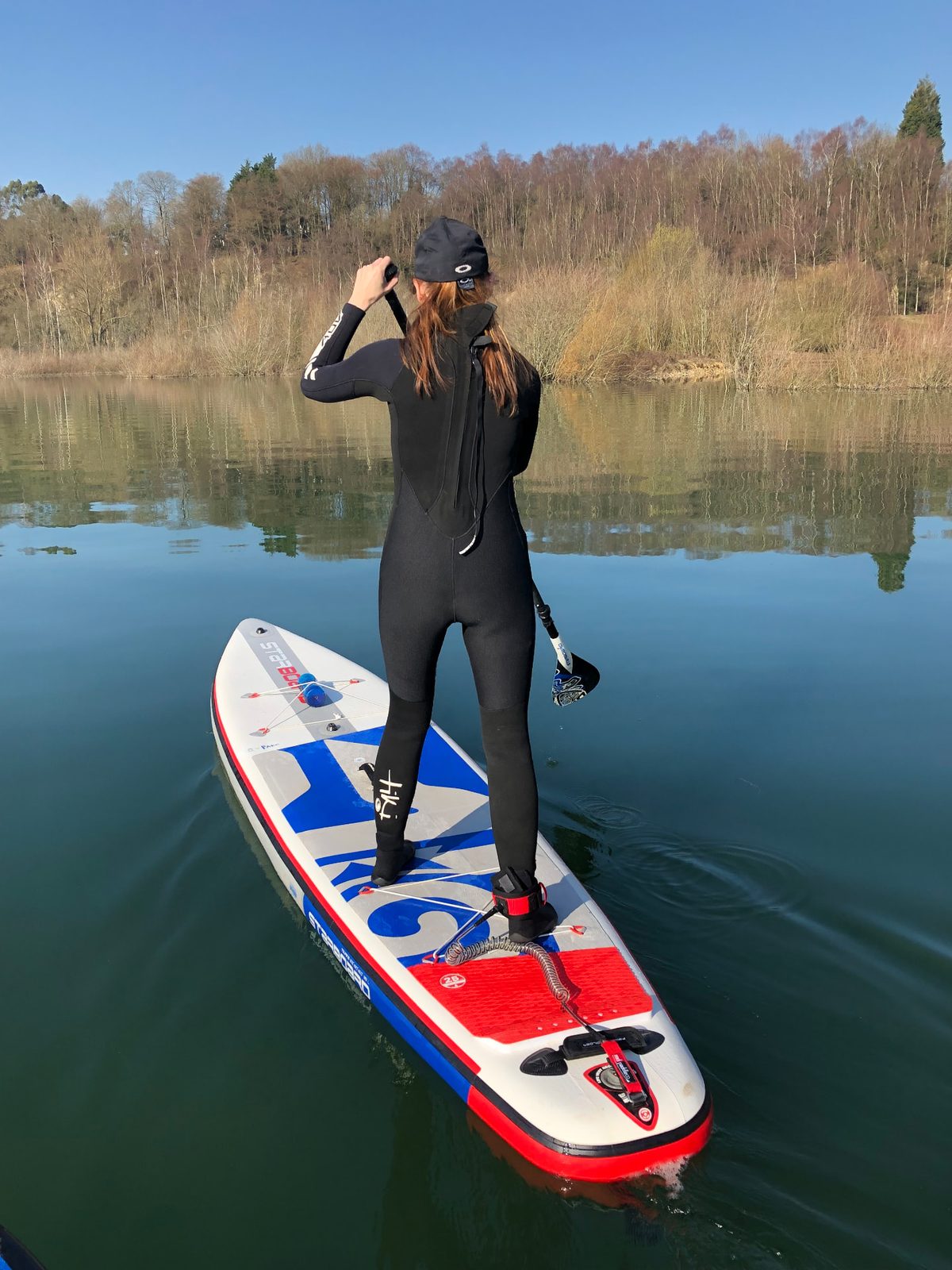
- Dress for immersion, not for the air temperature. In warmer months that is quick-drying layers and sun cover; from autumn onward it is a wetsuit or a drysuit with thermal layers underneath, plus gloves and a hat once the water is genuinely cold.
- Footwear
- Grippy, drainable shoes or neoprene booties you can launch, land and portage in. Inland banks and slipways are usually slippery, uneven or both.
Disclosure — some links on this page may earn SHACADEMY a commission. Not all links are commercial, and no recommendation here is made because of it. What we suggest is based on suitability, coaching experience and what holds up in real conditions.
Tell us what you’re trying to achieve.
Tell us what you're trying to achieve and we'll explore whether SHACADEMY is the right fit. Skip personally reviews every coaching enquiry.
Tell us what you’re trying to achieve →The first private coaching session is £150. Sessions are arranged individually and remain subject to suitable venue, permissions and operating conditions.