Paddleboarding the River Wey
Best for: First proper paddles · Building confidence · Technique work · Longer day journeys
Coaching: Available here where access and conditions allow. Hire: Well matched to our multi-day touring hire.
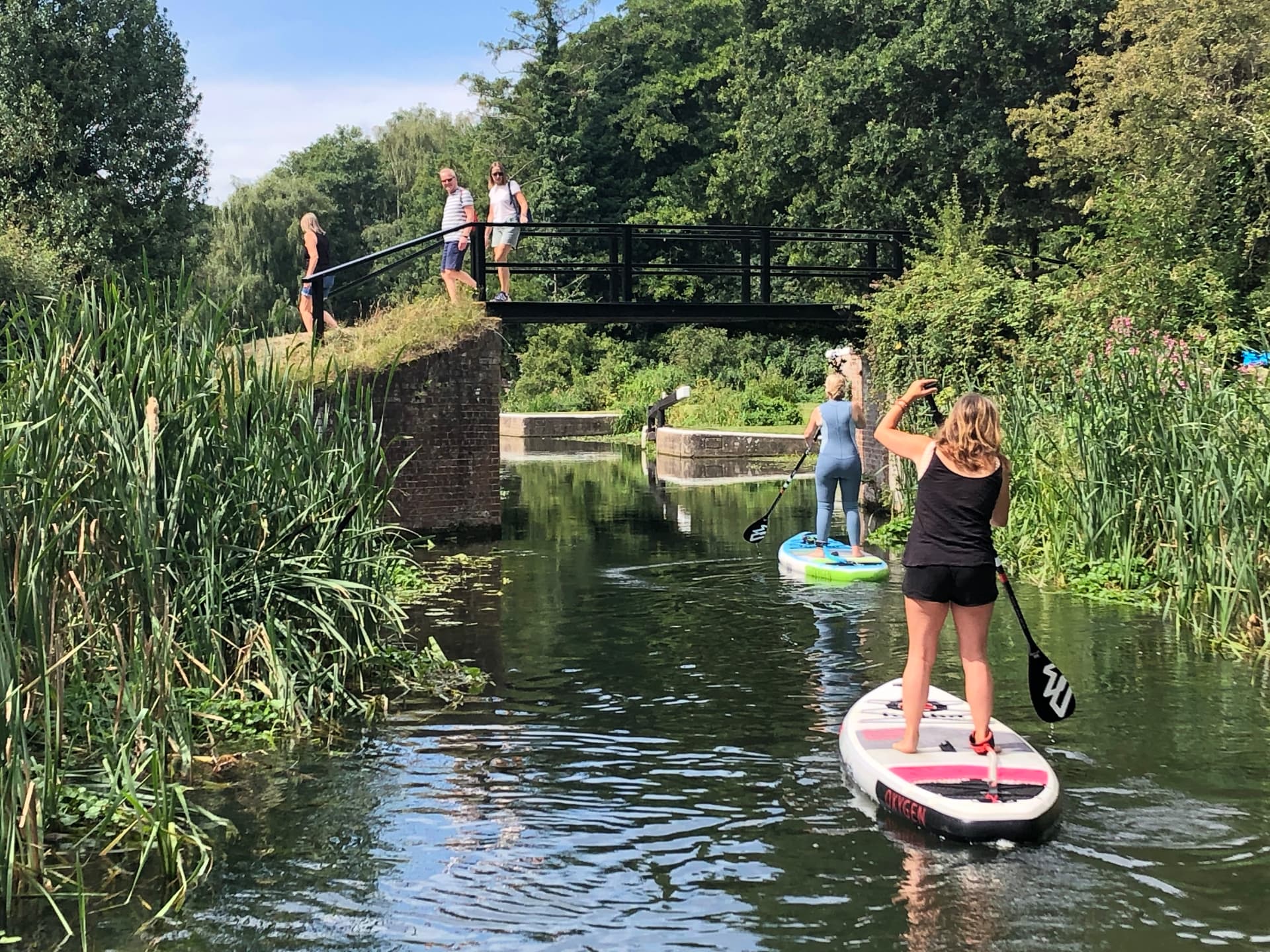
I know the Wey very well. I have paddled it from Godalming all the way down to the Thames, in sections and in longer days, and it is the river I return to most often when I want water that behaves predictably.
My connection with it is longer than a few paddles, too: The SHAC previously ran a centre on the River Wey, which I set up. SHACADEMY does not operate a centre there now — but that period is why I know the water, the locks and the practicalities as well as I do.
It is also where I did a good part of my training for the Yukon: long, repetitive, unglamorous mileage, which is exactly what the Wey is good for.
At a glance
- Skill level
- Beginner-friendly
- Water type
- Managed inland navigation — locks, weirs and mostly sheltered water
- Typical use
- First sessions, confidence, technique, and linked day journeys
- Licence / access
- A licence is required for paddlers on the River Wey & Godalming Navigations (National Trust)
- Coaching
- Well suited — where access and conditions allow
- Hire
- Genuinely suited to our multi-day touring hire
Licences, launch guidance, the portable craft booklet and current river conditions. Check this before every paddle — rules and conditions change.
National Trust — paddling the River Wey Navigations ↗Who this suits
Of the three locations here, the Wey is the one I would put a newer paddler on first. It is a managed navigation rather than a wild river: mostly sheltered, mostly slow, with locks and towpath alongside rather than committing sections you cannot leave.
That does not make it risk-free — no river is — but it does mean a beginner or improving paddler can concentrate on paddling rather than on survival.
- Complete beginners, including nervous ones, on a settled day.
- Improvers who want to paddle further without the water fighting back.
- Paddlers building stroke efficiency and distance.
- Anyone wanting a first taste of a real journey rather than a lap of a lake.
Why paddle here
The National Trust describes the Wey Navigation as running roughly fifteen and a half miles from Guildford to the Thames at Weybridge, with the Godalming Navigation adding around four more miles upstream — close to twenty miles of navigable water in total.
That length is the point. You can take a short beginner stretch, a half day, or link sections into something that genuinely feels like a journey, all on water that stays broadly manageable.
- Roughly 20 miles of navigable water between Godalming and the Thames (National Trust figures — approximate, and worth checking).
- Sheltered for much of its length, with towpath access alongside.
- Locks and structures that portable craft should portage around.
- Real distance available without needing tidal or coastal skills.
Good sections to explore
Route ideas we are comfortable pointing at, because a recognised source describes them. Distances and durations are approximate and taken from those sources — check the current version before planning around them.
Guildford to St Catherine's Lock
About 6 miles there and back, roughly 3 hours — approximate
The National Trust publishes this as an easy canoe trail through the middle of Guildford, past Dapdune Wharf and out into countryside. It is the most sensible first proper outing on the river, and it works as a linear paddle or a return trip.
National Trust canoe trail ↗Godalming down towards Guildford
Around 4 miles of Godalming Navigation — approximate
The upstream navigation is quieter and narrower than the Guildford stretch. Treat the locks as portages and plan how you are getting back — this is a linear paddle unless you arrange transport.
National Trust — Navigations overview ↗Guildford to the Thames at Weybridge, in stages
Roughly 15½ miles in total — approximate
This is the full lower navigation, and it is far better done as two or three linked days than one heroic push. Each lock is a break in the rhythm, and pacing yourself around them is a skill in itself. Work out launch and egress from current National Trust launch guidance rather than assuming.
National Trust — paddling information ↗
Rules, access and licence
The Navigations are managed by the National Trust, and paddlers — including paddleboarders — need a licence. Short-duration and annual options exist, and the Trust also publishes an information booklet for portable craft that is worth actually reading rather than skimming.
The licence conditions carry practical restrictions too. In summary, and paraphrased: portable craft should portage around locks rather than use them, mooring on the outside of bends or close to a lock is not allowed, navigating in flood conditions or outside daylight needs specific permission, racing and time trials are not permitted without permission, and larger organised groups need a separate arrangement with the Navigation Office.
Treat that as a description of the spirit of the rules, not the rules themselves — the current wording lives with the National Trust, and it changes.
- A licence is required for paddlers on the River Wey & Godalming Navigations.
- Portage around locks; do not moor on the outside of bends or beside a lock.
- Flood conditions and paddling outside daylight need specific permission.
- Organised groups and events need to be arranged with the Navigation Office.
- Insurance is your responsibility — Paddle UK membership is the usual route.
Conditions that change the paddle
The Wey is managed, not tame. After sustained rain it runs higher and faster, weir streams strengthen, and structures that are a non-event on a still day stop being a non-event. The National Trust publishes river-condition information, and in wetter months that is the first thing to look at.
Wind matters more than people expect on the open stretches, particularly if it is against you on the return leg of a there-and-back paddle.
- Recent rainfall: higher levels, stronger flow, more committing portages.
- Flood conditions: not a paddling day, and restricted in any case.
- Wind direction against your return leg.
- Other traffic — narrowboats, rowers, anglers — especially near locks and in Guildford.
- Weed and low summer levels on the shallower upper sections.
Skip’s take
First-hand experience and personal opinion — not a conditions assessment
If someone asks me where to learn to paddle properly in Surrey, this is the answer. The Wey lets you make mistakes without the river punishing you for them.
Having set up and run a centre on this water, my view of it is unromantic: it is a working navigation with locks, traffic and rules, and the paddlers who enjoy it most are the ones who respect that.
For Yukon training it was ideal precisely because it is unexciting — you can put in hours of honest mileage and let the technique settle.
What to know before you go
Sort the licence first, then read the portable craft information, then check current river conditions. In that order — the third one is the part people skip.
Plan your portages around locks, know where you can get off the water, and be honest about the return leg if you are paddling out and back.
- Licence sorted and carried.
- Current National Trust guidance and river conditions checked on the day.
- Portages, launch and egress planned rather than assumed.
- Leash appropriate to moving water — an ankle leash is not the right choice on a river.
- Buoyancy aid worn, not carried.
Coaching here with SHACADEMY
Private 1:1 paddleboard coaching with Skip can be arranged on the Wey where access and conditions allow. It is individual instruction, not a group beginner lesson: one paddler, one coach, and a session built around what you actually want to be able to do.
The Wey suits almost everything I coach — a first proper session for a nervous beginner, learning quickly rather than over a season, stroke and efficiency work, board control in gentle flow, and the journey skills that turn a paddler into someone who can plan and finish a day out.
- Nervous first-timers who would rather not learn in a queue.
- People who want to get competent quickly.
- Technique and efficiency — paddling further for less effort.
- River-reading, structures, portages and journey planning.
Private SUP coaching →Enquire about coaching here →
Hire for this route
The Wey is well matched to our multi-day inflatable touring hire: sheltered navigation water, sensible access, and enough distance to justify having a board for several days rather than a couple of hours.
Hire is a self-reliant arrangement. You plan the paddle, you hold the licence, and you make the decisions on the day — coaching is a separate service if you want the skills alongside the board.
Training for a race or adventure?
I trained on the Wey for the Yukon. If you have a race, a long journey or an expedition in front of you, this is efficient water for the boring, essential work — pacing, sustained mileage, kit and feeding, and holding technique together when you are tired.
Sessions can be built around your actual objective and event, rather than a generic progression.
Common questions
- Do I need a licence to paddleboard on the River Wey?
- Yes — the National Trust requires a licence for paddlers on the River Wey and Godalming Navigations, with short-duration and annual options available. Check the Trust's current guidance for what applies to you before paddling.
- How long is the navigable River Wey?
- The National Trust describes the Wey Navigation as around 15½ miles from Guildford to the Thames at Weybridge, with the Godalming Navigation extending it roughly four miles further to Godalming — close to 20 miles of navigable water. Figures are approximate.
- Is the River Wey suitable for beginner paddleboarders?
- It is the most beginner-friendly of the three locations we cover: managed, largely sheltered navigation water with towpath access. Suitability still depends on the paddler, the weather and recent rainfall, so check current river conditions and make your own assessment on the day.
- Can I have private SUP coaching on the River Wey?
- Private 1:1 coaching with Skip can be arranged on the Wey where access and conditions allow, from first sessions for nervous beginners through to technique, journey skills and race or expedition preparation.
Before you set out
This page is planning guidance written from experience — it is not a live conditions assessment. Water levels, flow, tides, weather, access points and permissions all change, and published distances, durations and rules can be revised at any time. Check current official guidance and the state of the water on the day, and make your own decision about whether to go.
Useful sources
Other locations
- River Arun
Tidal water that rewards planning and punishes assumption. Progression and adventure-training paddling, not a casual beginner day out.
- River Mole
The most technical of the three. Narrow, level-dependent water that asks for real paddle skills and local knowledge.