Paddleboarding the River Arun
Best for: Progression paddlers · Tide and planning skills · Distance training · Expedition preparation
Coaching: Available here where access and conditions allow. Hire: Suitability depends on paddler, conditions and route.
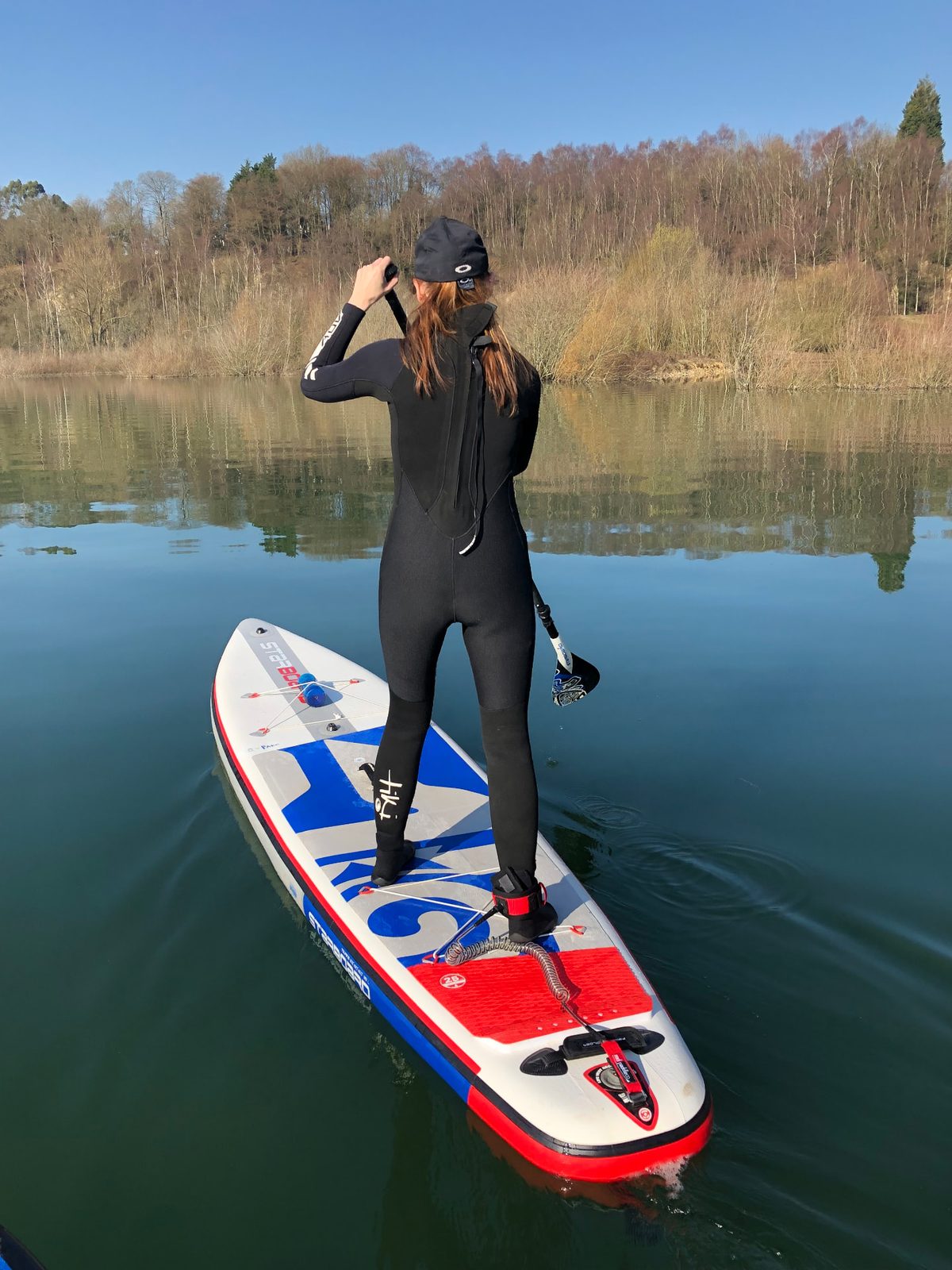
The Arun is one of the two rivers I trained on for the Yukon, alongside the Wey. The two could not be less alike, and that is exactly why both were useful.
The Arun is tidal. Get the planning right and it moves you along beautifully. Get it wrong and you will spend hours working against water that has no interest in your schedule.
At a glance
- Skill level
- Intermediate
- Water type
- Tidal river — flow reverses, and can run fast in places
- Typical use
- Progression, distance training, journey and expedition preparation
- Licence / access
- No National Trust-style navigation licence, but harbour authority rules apply below Arundel — check current guidance
- Coaching
- Suited to planning, tide and journey coaching — where access and conditions allow
- Hire
- Conditional — depends on paddler, conditions and route
Littlehampton Harbour Board is the navigation authority for the harbour below Arundel and publishes current navigation, tide and safety guidance. Its own material describes the Arun as a fast-flowing tidal harbour where preparation matters.
Littlehampton Harbour — navigation, tides and safety ↗Who this suits
I would not send a first-time paddler here as a casual day out. The Pulborough to Arundel stretch is tidal, and Paddle UK's Go Paddling route information grades it as moderate rather than easy.
This is progression water. It suits paddlers who already have a reliable stroke and a settled board, and who want to add planning, commitment and real consequence to their paddling.
- Paddlers comfortable on flat water who want the next step.
- Anyone learning to plan properly around tide, current and weather.
- Distance and endurance training with a genuine reason to get it right.
- Race, journey and expedition preparation.
Why paddle here
Tidal rivers teach decision-making in a way that still water cannot. Timing matters, direction matters, and the margin between an excellent day and a very long one is a couple of hours of planning.
It is also a genuinely good journey. The route runs through quiet countryside and past wetland reserves, with the chalk escarpment at Amberley and then Arundel's castle and cathedral announcing the end of the paddle. For anyone training towards something bigger, that combination of scale and consequence is valuable.
- Real tidal flow to plan around rather than ignore.
- Big-feeling landscape and a proper sense of journey.
- Excellent rehearsal for expedition-style days.
Good sections to explore
Paddle UK's Go Paddling route information describes the main trail here. Distances and durations below are approximate and taken from that source — read the current version, and treat tide planning as the real work.
Pulborough to Arundel
Around 13 miles, typically 3–5 hours, graded moderate — approximate
The classic one-way trip, running through quiet countryside and past Pulborough Brooks and Amberley Wild Brooks, with the chalk escarpment at Amberley about halfway. Landing options and parking are limited along the way, and the formal egress is in Arundel. This is a paddle to plan around the tide, not around the clock.
Go Paddling — Pulborough to Arundel trail ↗A shorter tide-assisted out-and-back
Half the distance, roughly half the day — approximate
Because the flow reverses, a sensible way to learn this river is to ride the tide one way and return as it turns, rather than committing to the full one-way trip. Which section works depends entirely on the day's tide, so build the plan from current tidal predictions rather than from a fixed idea.
Littlehampton Harbour — tides and navigation ↗
Rules, access and authority
There is no National Trust-style navigation licence here as there is on the Wey, but that does not make the Arun a free-for-all. Below Arundel you are in Littlehampton Harbour, where the Harbour Board is the navigation authority, sets general directions for everyone on the water and publishes safety guidance aimed at paddleboarders as well as vessels.
Upstream, launch and egress points are mostly informal and often on private land, with limited parking. Establish access for the specific points you intend to use rather than assuming it, and do not treat a landing mentioned in a route description as permission.
- Littlehampton Harbour Board is the authority for the harbour below Arundel — read its current directions and safety guidance.
- Launch and egress upstream are often informal, with limited or no parking.
- Paddle UK membership is the usual route to insurance and access guidance.
- Landing and camping are not welcome everywhere along the bank; assume not unless it is clearly permitted.
Conditions that change the paddle
Tide timing, current, weather and recent rainfall all interact here, and each one can turn a good plan into a bad one. We deliberately do not publish tide times or a fixed schedule in evergreen copy — a plan that worked last month can be the wrong plan today. Work from current tidal predictions and the harbour authority's own guidance.
Wind against tide is the combination to watch: it stands the water up and makes a stable board feel much less stable. Add recent heavy rain and the fresh water coming down the catchment on top of the ebb, and the river changes character again.
- Tide state and timing — direction of flow, and when it turns.
- Strength of current, which can be considerable, particularly nearer the harbour.
- Wind strength and direction, especially wind against tide.
- Recent rainfall adding to the flow coming downstream.
- Your own turnaround time and exit options, decided before you launch.
Skip’s take
First-hand experience and personal opinion — not a conditions assessment
I trained here for the Yukon because it makes you plan. You cannot bluff a tidal river — either you worked out the timing or you did not, and the water tells you within twenty minutes.
It is not a beginner recommendation and I will not dress it up as one. Learn on the Wey, then come here when the step makes sense.
Done properly it is one of the best training days in the South East. Done carelessly it is a very long afternoon.
What to know before you go
Build the plan around the tide first and everything else second: direction, launch window, turnaround time, and where you can get off if it stops working.
No river is safe, and this one asks more of you than the Wey. Suitability here depends on the paddler, the plan and the day.
- Current tidal predictions and harbour guidance checked on the day.
- Direction and window chosen around the tide, not your diary.
- Exit points and turnaround time agreed before launching.
- Quick-release belt leash for moving water, not an ankle leash.
- Buoyancy aid worn, means of calling for help carried, someone told where you are going.
Coaching here with SHACADEMY
Private 1:1 coaching with Skip can be arranged on the Arun where access and conditions allow. On this water, coaching is mostly about judgement: tide and flow planning, holding technique when the water is moving, pacing, and building the confidence to commit to a plan and adjust it sensibly.
For a genuinely nervous beginner I would normally start you on the Wey and bring you here when it is the right step — not before.
- Tide, current and route planning done properly.
- Technique that holds up when the water is moving.
- Journey skills, pacing and contingency thinking.
- Progression from flat water towards committing days.
Private SUP coaching →Enquire about coaching here →
Hire for this route
Our multi-day touring hire can work here, but I will not pretend it is a straightforward match. On tidal water, suitability depends on the paddler, the conditions and the specific route — not on the board alone.
If you are considering hiring for an Arun paddle, be confident in your own tide planning and self-rescue first. If you are not, coaching is the better first step.
Training for a race or adventure?
This is where the Arun earns its place. I used it as part of my Yukon preparation because it demands planning, sustained effort and the discipline to work with the water rather than against it.
If you have a race, a long journey or an expedition ahead, sessions here can be built directly around that objective — including the parts most people neglect, like feeding, pacing and decision-making when you are tired.
Common questions
- Is the River Arun tidal?
- Yes. The Pulborough to Arundel stretch is tidal, and below Arundel you are in Littlehampton Harbour, whose own guidance describes a fast-flowing tidal harbour where preparation and awareness are essential.
- How far is Pulborough to Arundel by paddleboard?
- Paddle UK's Go Paddling route information describes it as roughly 13 miles, typically three to five hours, graded moderate and one-way. Treat those figures as approximate and check the current route information — actual timing depends heavily on the tide.
- Is the River Arun suitable for beginner paddleboarders?
- We position the Arun as progression and adventure-training water rather than a casual beginner recommendation. It needs proper tide planning and more skill than a sheltered navigation such as the River Wey.
- What should I plan around on the Arun?
- Tide timing and direction, current strength, wind, and recent rainfall — together. Use current tidal predictions and the harbour authority's guidance on the day rather than any fixed published plan, and set your exit points and turnaround time before launching.
Before you set out
This page is planning guidance written from experience — it is not a live conditions assessment. Water levels, flow, tides, weather, access points and permissions all change, and published distances, durations and rules can be revised at any time. Check current official guidance and the state of the water on the day, and make your own decision about whether to go.
Useful sources
Other locations
- River Wey
The best of the three for beginners and improving paddlers. Sheltered navigation water through Surrey, from Godalming to the Thames.
- River Mole
The most technical of the three. Narrow, level-dependent water that asks for real paddle skills and local knowledge.